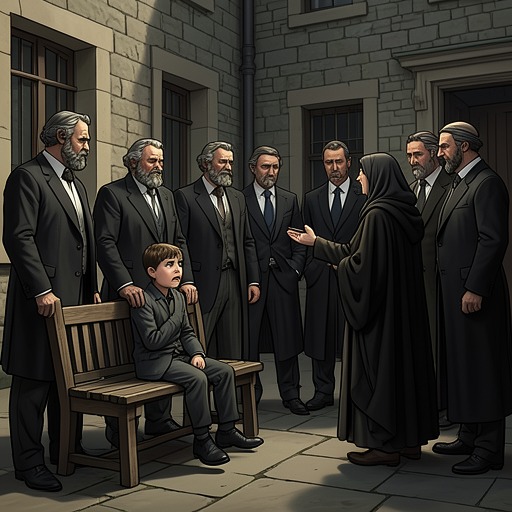
Jean de Carrouges—Jean III de Carrouges father–son relationship
The Last DuelThe relationship between Jean III de Carrouges and his eldest son, Jean IV, was shaped by a shared inheritance and a shared place in Norman military and feudal life. Jean III was an experienced captain and royal servant; Jean IV grew into a battle-hardened squire who expected to succeed to his father’s lands and standing. Their bond is most clearly visible not through accounts of private affection, but through the estate, office, and obligations that passed—or failed to pass—from one generation to the next.
Family and Inheritance
Jean III was in his sixties in 1380, when the Carrouges family was among the Norman nobles who swore fealty to the young King Charles. He had fought in many campaigns against the English and served as a vassal of the Count of Perche, who appointed him military captain of Bellême. Jean III also held the office of viscount, acting as the king’s local official. His service to the crown extended beyond campaigning: in 1364, he helped raise money for King Jean’s ransom.
Jean III was married to Nicole de Buchard, a well-born woman, and had at least three children. Jean IV, the eldest, stood to receive the main share of the family inheritance and to preserve the Carrouges name. His younger brother Robert entered the priesthood, while his sister Jeanne married a knight and took part of their father’s land as her dowry. Nicole held lands in her own name and would retain those and their revenues if Jean III died before her. The arrangement placed Jean IV’s future at the center of the family’s succession, while also defining what would be divided among his mother and siblings.
The inheritance at stake was more than a title or a single residence. Jean’s chief legacy was the castle and lands at Carrouges, whose hilltop town commanded fertile farmland and stood near an important crossroads. The family had left the older castle, attacked and burned by the English, and built a nearby fort after 1367 at the order of King Charles V. Its surviving keep, now part of the Château de Carrouges, embodied the family’s presence on land that had to be defended as well as inherited. Jean IV’s expected succession therefore carried both material wealth and the continuing responsibility of maintaining the family’s place in Normandy.
Shared Service and Feudal Obligations
Father and son served Count Robert of Perche, who inherited his domain in 1367. At the count’s court, both men performed homage to their much younger lord and swore fealty. For the following decade they attended him, yielded their annual rents, helped enforce his decrees, and answered his military calls to fight the English. Their relationship thus belonged to a larger chain of obligations: their service connected the Carrouges household to its lord, while the lands and posts held by the family secured its standing within that hierarchy.
When Count Robert died without an heir in 1377, his lands reverted to his overlord, King Charles V, who granted Perche to Robert’s older brother, Count Pierre of Alençon. Jean III and Jean IV consequently had to transfer their allegiance to a new lord. The change affected both generations, but it was Jean IV who would later feel its consequences most sharply. The family’s future depended not only on what his father had held, but also on the decisions of the lord who now controlled appointments and important fiefs.
By 1380 Jean IV was already an experienced soldier in his forties, though he held the rank of squire. He commanded a troop of squires in campaigns to drive the English from Normandy and, like his father, pursued the military career through which a nobleman could gain standing and wealth. The two generations shared an identity rooted in service, but Jean III’s established authority and Jean IV’s ambitions were not the same: the son was still waiting for the inheritance and offices that would make his own position secure.
The Inheritance and the Lost Captaincy
Jean III’s death in 1382 brought Jean IV the lands he had expected to receive and left open the captaincy of Bellême, which his father had held for twenty years. Jean IV expected to succeed him. Captaincies often passed from father to son, and Bellême was a particularly prestigious appointment: a stronghold of strategic importance whose captain commanded a garrison and held a prominent place in the region. In Jean IV’s view, the office belonged to the inheritance of service as well as to the family’s expectations.
But the captaincy was not simply private property that transferred automatically with the estate. Count Pierre had acquired rights to Bellême through his deceased brother Robert and retained the power to choose its captain. He entrusted the castle to another man. The distinction between family inheritance and lordly appointment became decisive: Jean IV received his father’s lands, but not the position that had marked Jean III’s authority.
The denial wounded Jean IV more deeply because Bellême had belonged to his father. He regarded the decision as an unjust deprivation of a legacy, and its public character mattered. At Count Pierre’s court in Argentan and among the local nobility, the appointment suggested that Jean IV was not considered worthy to follow his father and command the old fortress and its garrison. His father’s former office became, in the son’s hands, both a measure of what he believed he should inherit and a sign of what his lord refused to grant.
Consequences for Jean IV
Jean IV responded by bringing suit against Count Pierre, as he had previously done over another disputed fief. The lawsuit failed. Rather than restoring the office, it further alienated him from the count, whose relationship with his vassals was a foundation of their political and social order. The quarrel did not directly concern Jacques Le Gris, but Le Gris was Count Pierre’s protégé and, after the earlier dispute between Jean IV and the count, likely stood with his lord. The conflict over Bellême therefore widened the rift between the former friends as well as between Jean IV and his new overlord.
The father–son relationship consequently reaches its clearest narrative turning point at Jean III’s death. His lands passed to the son who was expected to preserve the family, but the office that had joined the family’s name to military authority remained subject to the lord’s choice. Jean IV inherited responsibility and property without inheriting his father’s full standing. The resulting lawsuit shows how succession could carry a grievance alongside an estate: what Jean III had held as a position of service became, for Jean IV, a denied claim that shaped his relations with Count Pierre and his place at court.